
Aaron ErhardT
Aaron Erhardt
Jan 20, 2026
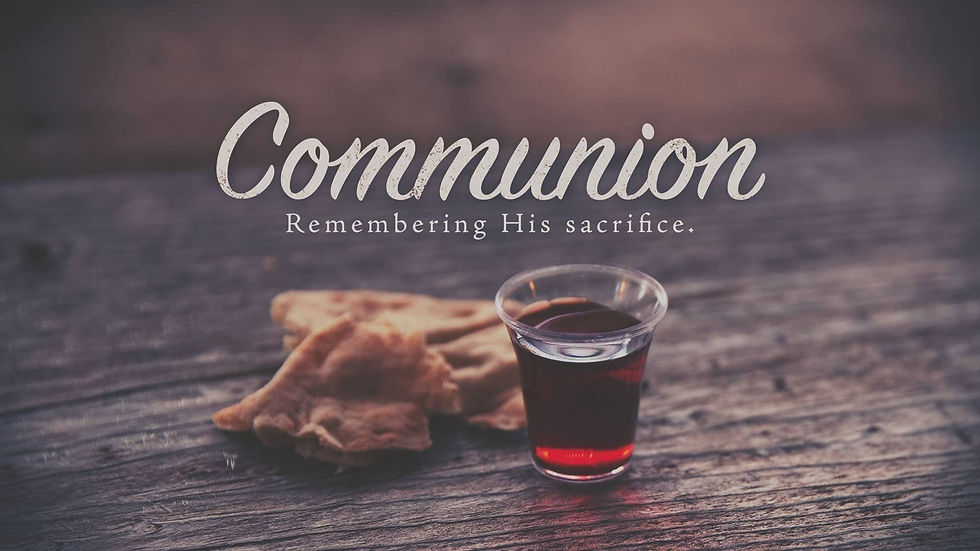
The Lord's Supper is the most ingenious memorial ever established. One can easily see the wisdom of God in it.
The Lord's Supper is the most ingenious memorial ever established. One can easily see the wisdom of God in it. First, the elements of bread and juice are readily available to every class of people. Second, the symbolism of unleavened bread representing his sinless body and the fruit of the vine being blood-colored and secured only by the crushing of the grapes is a powerful parallel. Third, one does not have to travel to Jerusalem or to some great Cathedral to observe communion, it can easily be provided anywhere the church meets. In fact, Astronaut Buzz Aldrin took communion on the moon back in 1969. Finally, it is interactive. Everyone "participates" in the body and blood of Christ (1 Corinthians 10:16). Indeed, communion is a brilliant way to remember the greatest sacrifice in human history.
On the night he was betrayed, Jesus instituted the Lord's Supper (Matthew 26:17-26; Mark 14:12-25; Luke 22:7-30). This act of worship is designed to commemorate the death of Christ until he comes again. Paul wrote, "For I received from the Lord what I also delivered to you, that the Lord Jesus on the night when he was betrayed took break, and when he had given thanks, he broke it, and said, 'This is my body, which is for you. Do this in remembrance of me.' In the same way also he took the cup, after saying, 'This cup is the new covenant in my blood. Do this, as often as you drink it, in remembrance of me.' For as often as you eat this bread and drink this cup, you proclaim the Lord's death until he comes" (1 Corinthians 11:23-26). Notice that the bread and cup represent the body and blood of Christ. They are emblematic of the sacrifice he made on our behalf.
Christians need to appreciate the sacredness of communion. It is not something to be done haphazardly or slipshod. Partakers should mediate on what they are doing and why they are doing it. Paul said, "Whoever, therefore, eats the bread or drinks the cup of the Lord in an unworthy manner will be guilty concerning the body and blood of the Lord. Let a person examine himself, then, and so eat of the bread and drink of the cup. For anyone who eats and drinks without discerning the body eats and drinks judgement on himself" (vv. 27-29). To "examine" means to prove or test. Christians should examine themselves before partaking of the Lord's Supper.
The early Christians broke break "on the first day of the week" (Acts 20:7). Whereas the old covenant placed special significance on the seventh day, the new covenant places special significance on the first day. It was on the first day of the week that Jesus rose from the dead, the church of Christ was established, and Christians assembled for worship.
The Didache, a Christian document from around 100 A.D., says, "On every Lord's Day, his special day, come together and break bread and give thanks" (14:1). The "Lord's Day" is a reference to Sunday. Justin Martyr affirms that churches were doing that later in the second century, when he said they gathered "on the day called Sunday" and partook of "bread and wine" (Apology 1:67).
Some argue that because Acts 20:7 does not say "every" first day of the week Christians are not obligated to observe the Lord's Supper weekly. Such reasoning is illogical. For instance, God commanded the Jews to observe the Sabbath in Exodus 20:8. It says, "Remember the Sabbath day, to keep it holy." Notice that it does not say "every" Sabbath. Does that mean the Jews could skip a few? Were the Jews free to have a monthly or quarterly Sabbath observance instead of a weekly one? The very thought is absurd. We all recognize that the command to keep holy the Sabbath would include every Sabbath even though it does not use the word "every." The same is true with the Lord's Supper. We are to observe it every Sunday.
The New Testament not only reveals "when" to eat the Lord's Supper, but it also reveals "where" to eat it -- in the assembly. The early Christians "gathered together to break bread" (Acts 20:7). Consider the context of 1 Corinthians 11: "when you come together" (v. 17), "when you come together as a church" (v. 18), "when you come together" (v. 20), "when you come together to eat" (v. 33), "when you come together" (v. 34). Hence, the Lord's Supper is an act of worship that is to be observed collectively (Acts 2:42). However, we are not merely communing with those in our assembly but with Christians around the world and, most importantly, with the Lord.